
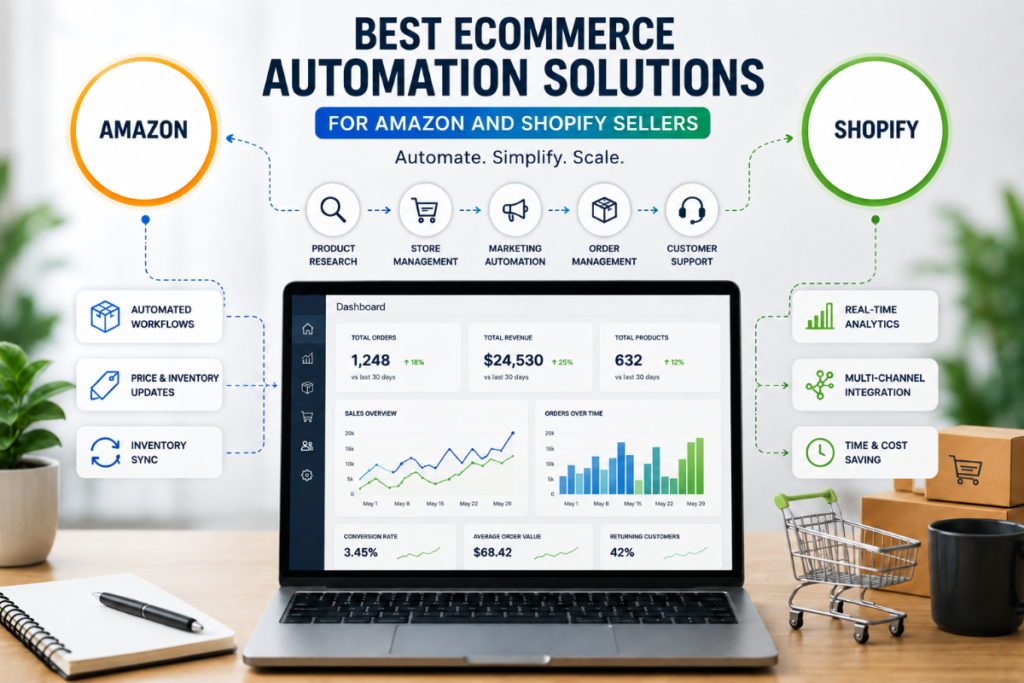
There comes a point in every seller’s journey where you realize that working harder is not going to cut it anymore. You are already putting in long hours, your store is getting orders, things look good on the surface but somewhere between managing inventory, replying to customer emails, updating listings, and tracking shipments, the day just vanishes. I have spoken to enough Amazon and Shopify sellers to know that this is not a rare experience. It is practically a rite of passage. And the ones who figure it out early are the ones who start looking seriously at ecommerce automation solutions before burnout forces them to.
This is not about replacing the work you do. It is about making sure your time goes toward the things that actually need your brain product research, building your brand, finding better suppliers, understanding your customers. The repetitive stuff? That can run on its own.
The Point Where Manual Just Stops Working
Most sellers start out doing everything by hand. That makes sense at the beginning. You have ten orders a day, you know every product in your catalog, and keeping track of things in a spreadsheet feels perfectly fine. There is nothing wrong with that phase.
But then things start to grow. Maybe you add a second sales channel. At some point, you launch a few more SKUs to expand your catalog. Then the order volume suddenly jumps overnight after running ads. Suddenly the same spreadsheet that felt manageable is now the thing causing you the most stress in your business.
What happens next is predictable. You start making mistakes. An item goes out of stock because you did not catch the inventory level dropping. A customer does not get their order confirmation because it slipped through. A competitor drops their price and you do not notice for three days, which means you lost the buy box for seventy two hours straight. These are not signs that you are bad at running a business. They are signs that you have outgrown manual operations.
This is the exact moment when investing in the right ecommerce automation solutions starts making real financial sense.
What You Can Actually Hand Over to Automation
A lot of sellers hesitate because they are not sure what automation can realistically handle. The answer, honestly, is more than most people expect.
📦 Inventory Management
Keeping stock levels accurate across Amazon and Shopify simultaneously, without any manual syncing, is something that software does far better than any human can. Good inventory tools track your levels in real time, warn you before you run out, and in some cases automatically trigger reorders based on your sales velocity.
🛒 Order Processing
From payment confirmation all the way through to the customer receiving their tracking number, most of that chain can be automated. The order comes in, the warehouse gets notified, the label gets generated, and the customer gets their email without you touching any of it.
💰 Amazon Repricing
A good automated repricer watches the competition and adjusts your prices within whatever boundaries you set, keeping you in the buy box without you having to babysit your listings throughout the day.
📧 Email and SMS Marketing
Abandoned cart sequences, post purchase follow ups, review requests, loyalty rewards when these are running properly in the background, they generate revenue that you would otherwise just be leaving on the table.
🤝 Customer Service Automation
A lot of the questions your support inbox receives are the same ten questions asked in different ways. Chatbots and automated response templates handle those without any human involvement, which means your team only deals with the situations that actually need a real person.
Tools That Are Actually Worth Your Money
There are a lot of options out there, and not all of them deliver on what they promise. These are the ones that consistently show up in conversations with sellers who have actually built working automation systems.
Helium 10 and Jungle Scout
Helium 10 covers a wide range of functions keyword research, listing optimization, inventory tracking, profit analytics and it does most of them well. For someone looking at ecommerce automation solutions that cover the full Amazon operation in one place, Helium 10 is usually near the top of the list. Jungle Scout is a strong alternative, particularly if supplier management and sales forecasting are higher priorities for your business.
Linnworks
Linnworks is the tool that multichannel sellers tend to discover right around the time they realize managing Amazon and Shopify separately is no longer sustainable. It pulls everything into one place orders, inventory, shipping and lets you set rules that apply across all your channels at once. When an order comes in from either platform, everything updates automatically. It is genuinely one of those tools where you wonder how you managed without it.
Zapier and Make
These platforms let you connect different apps and create automated workflows without writing any code. You could set up a workflow where a new Shopify order triggers a Slack notification, creates a task in your project management tool, and updates a Google Sheet all at once. They are especially valuable for sellers who have specific workflows that prebuilt tools do not quite cover.
Klaviyo
Klaviyo is the email and SMS platform that most experienced Shopify sellers eventually land on. You can segment customers based on what they bought, how much they spent, how long ago they purchased, whether they have opened your last five emails and then automate sequences that feel personal even though they are running completely on their own. The results speak for themselves, which is why it has become so widely adopted.
Repricer Express and Seller Snap
Repricer Express works well for sellers with straightforward needs and a manageable catalog size. Seller Snap uses a more advanced algorithmic approach that factors in competitor behavior patterns, which tends to produce better results for high volume sellers where even small improvements in buy box percentage translate into significant revenue differences.
ShipStation and ShipBob
ShipStation is software that connects your sales channels, applies your shipping rules, and generates labels automatically. ShipBob goes a step further as a full third party logistics provider they physically store your inventory and handle the picking, packing, and shipping on your behalf. Which one makes sense depends on whether you are running your own warehouse or looking to outsource fulfillment entirely.
How to Build a Stack That Does Not Create New Problems
Here is something nobody talks about enough. Buying a collection of automation tools without thinking about how they work together can actually make your life harder, not easier. You end up with multiple dashboards showing slightly different data, integrations that break without warning, and more subscriptions to manage than you have time for.
The smarter approach is to start with the single biggest operational pain point in your business right now and fix that properly first. If inventory accuracy is costing you money, start there. If fulfillment is eating hours every day, start there. Get one piece of the system working smoothly before adding anything else.
Once that foundation is solid, you can add the next layer. Most sellers find that after solving inventory or fulfillment, email marketing automation delivers the next biggest return. Then repricing if you are on Amazon. Then custom workflow tools for the more specific needs that come up as things scale. The goal is a stack where every tool has a clear job and nothing is overlapping or fighting with anything else.
What to Actually Check Before You Buy
With so many ecommerce automation solutions available, a few practical filters help narrow things down quickly.
Integration Reliability
A tool that claims to integrate with Shopify but constantly breaks or requires manual syncing creates more headaches than it solves. Always check reviews specifically about integration reliability before committing.
Scalability
The tool that works fine for fifty orders a month might completely fall apart at five hundred. Understand the pricing tiers and technical limits before you build your operations around something.
Support Quality
When something breaks during a peak sales period, a fast and knowledgeable support team is worth a lot. Check whether the platform offers live support or only email tickets, and look at how responsive they actually are based on what other users report.
Trial Periods
Do not set up a demo environment run your actual workflows through it with real data. That is the only way to know whether a tool is going to hold up in your real operation.
What Changes When You Get This Right
Sellers who have properly implemented ecommerce automation solutions tend to describe a similar shift. It is not just that their days get easier, though they do. It is that they start thinking about their business differently. When you are not stuck in operational tasks all day, you have the mental space to actually think about strategy where the next growth opportunity is, which products are worth expanding, what your customers are actually telling you through their behavior.
There are sellers running large Amazon businesses with very lean teams because automation is carrying most of the operational weight. There are Shopify store owners who have built passive revenue streams through properly configured marketing automation that runs in the background while they focus on other things. None of that happens by accident. It happens because someone made a deliberate decision to stop doing manually what software can do better.
Where to Go From Here
If you are just starting to think about this, the most useful thing you can do right now is spend an hour tracking exactly where your time goes in a typical week. Look at which tasks you are doing repeatedly. Look at which ones require actual judgment and which ones are just execution. The execution tasks are almost always automatable.
Pick one. Set it up properly. Watch what happens to your available time and your error rate. Then add the next one.
The best ecommerce automation solutions are not the ones with the longest feature lists. They are the ones that solve your actual problems reliably and let you get on with the parts of your business that genuinely need you. For Amazon and Shopify sellers who are serious about growing, that is a distinction worth keeping in mind.