
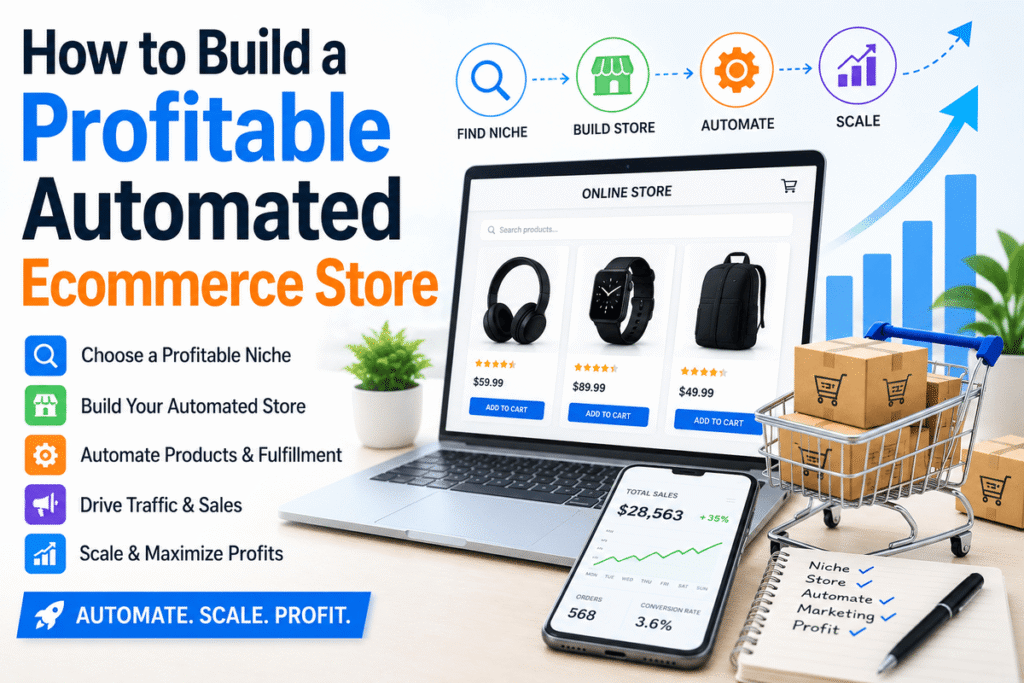
Honestly, when I first got into ecommerce, the dream was simple. Build a store, list some products, and watch the money come in. What actually happened was something completely different. Manually processing every order, tracking inventory in spreadsheets, writing customer emails one by one, adjusting prices by hand, checking stock levels every morning the entire day would disappear and at the end of it, nothing meaningful had actually moved forward. The people who genuinely built profitable stores did one thing differently from everyone else. They built an automated ecommerce store in a way that made the system do the work, not them. And that single shift in approach is what separates a business that grows from one that just survives.
This guide exists for the seller who wants to build something real, not just another store they have to babysit every single day.
Why Most Ecommerce Stores Never Get Where Their Owners Wanted Them to Go
Products are rarely the reason stores fail to reach their potential. The niche is usually fine. The pricing is often competitive enough. What kills most stores, quietly and slowly, is operations. Sellers get so buried in repetitive daily tasks that they never get to spend real time on the things that actually move revenue forward.
Think about what a typical manual seller’s day looks like. Wake up, check orders, process them one by one, update inventory, answer the same three customer questions that came in overnight, check competitor prices, adjust listings, send follow up emails. By the time all of that is done, there is barely any energy left for strategy, product development, or marketing. And then the next morning it starts all over again.
The sellers building profitable stores are not necessarily smarter or more experienced. They just stopped letting their days get consumed by tasks that a well configured system could handle without any human involvement at all.
Choose a Business Model That Actually Supports Automation
This is something very few people think about seriously at the beginning, and it matters more than most of the decisions that come after it. Not every ecommerce model is equally friendly to automation. Picking the right one from the start makes everything downstream significantly easier.
📦 Amazon FBA
Still the most automation compatible model available. Amazon handles warehousing, picking, packing, and shipping. Your core responsibilities shrink down to inventory replenishment, listing management, and advertising. All three can be largely automated, which means an Amazon FBA business can get genuinely close to hands off operation once systems are properly in place.
🛒 Shopify Dropshipping
A customer places an order, it routes to your supplier automatically, fulfillment happens, the customer gets their tracking notification, and your involvement throughout that entire chain is essentially zero. Your energy goes toward finding winning products and driving traffic, both of which also have strong automation options available.
🏭 Shopify with Third Party Logistics
You own your inventory but outsource the physical storage and fulfillment to a warehouse that integrates directly with your store. You get more control over packaging and the customer experience than dropshipping offers, while still keeping fulfillment largely hands off. Whatever model you land on, ask one question before committing do strong automation tools exist for the main operational tasks this model requires?
Product Selection Is Not the Boring Part, It Is the Foundation
Automation makes a good business more efficient. It cannot rescue a bad product selection. This is the step that gets rushed most often because sellers are eager to get to the exciting parts. But a poorly chosen product will consume every advantage that automation provides and still leave you with thin or negative margins.
For Amazon FBA sellers, tools like Helium 10 and Jungle Scout give you demand data, competition analysis, seasonal trends, and estimated profit margins before you commit a single dollar to inventory. Use them properly. Making product decisions based on gut feeling in a marketplace as competitive as Amazon is how sellers end up sitting on inventory that does not move.
For Shopify sellers, products with consistent, predictable demand work far better for automated stores than trend chasing products, because consistent demand means your automated systems can operate predictably without constant manual override.
Run the margin math before anything else. Your automation tools have monthly costs. Your logistics provider has fees. Advertising costs money. If the product margin does not comfortably absorb all of those costs and still leave you with meaningful profit, no amount of automation sophistication is going to fix that.
Build Your Tech Stack Before You Feel Like You Need It
This is the mistake that costs sellers the most. The typical approach is to run everything manually at the start, figure it will get fixed when the business grows, and then discover that when the business actually does grow, there is no time or mental bandwidth left to set up proper systems. The smarter path is to build your automated ecommerce store with the right infrastructure from day one, even when order volumes are low.
Inventory Management: Linnworks and Skubana
Real time stock visibility, automated reorder triggers when levels drop below your set threshold, and sync across platforms without any manual input. Running out of stock on your best selling product at the wrong moment is an expensive problem, and it is one that proper inventory automation prevents entirely.
Order Fulfillment: ShipBob and ShipStation
Shopify sellers working with a third party logistics provider like ShipBob get automated order routing, label generation, and customer tracking notifications built into the integration. ShipStation is a strong option for sellers who want to manage their own shipping relationships while still automating the label and notification process.
Email and SMS Marketing : Klaviyo
Abandoned cart sequences, post purchase flows, review request automations, win back campaigns for lapsed customers — set these up once and they run continuously without you touching them. The revenue that a properly built Klaviyo account generates from existing customers every month is essentially profit with no additional acquisition cost attached to it.
Amazon Repricing: Seller Snap and Repricer Express
The Amazon marketplace moves fast enough that manual pricing simply cannot keep up. Automated repricing keeps you competitive in the buy box within the margin guardrails you define, without requiring you to watch the platform throughout the day. For any serious Amazon seller this is not optional.
Configure Your Automations to Actually Perform
Buying tools and configuring them well are two entirely different things, and most sellers underestimate how much the configuration matters. A poorly set up automation can actually cause more problems than doing things manually, because it creates errors at scale rather than one at a time.
Set Inventory Reorder Points Based on Real Data
Your reorder points need to account for your actual supplier lead times and your real sales velocity, not rough estimates. If your supplier needs three weeks to deliver and you are selling sixty units a week, your reorder trigger needs to fire early enough that you never actually reach zero.
Map Out Email Flows Before Building Them
Know the full journey you want a customer to take from their first purchase onwards. A well designed post purchase sequence builds trust, surfaces relevant products for a second purchase, requests a review at precisely the right moment, and keeps the customer connected to your brand over months.
Automate Customer Service for Repeated Questions
Order status, shipping windows, return processes, product questions — automated responses and chatbot flows for these common queries mean your support team only deals with situations that genuinely require human judgment, which dramatically reduces the cost and time of running customer service.
Do Not Forget to Automate Your Advertising
An automated ecommerce store is not just about the operational side. The traffic and advertising side of the business has strong automation options that the fastest growing sellers take full advantage of.
📊 Amazon Advertising Automation
Tools like Perpetua, Pacvue, and Helium 10 Adtomic let you set performance based rules for bid adjustments, keyword harvesting, and budget allocation. You define your target ACOS and the guardrails you want to operate within, and the software optimizes continuously within those parameters.
📱 Shopify Paid Social Automation
Meta and Google advertising platforms have built in automation for bidding and budget allocation. Attribution tools like Triple Whale and Northbeam give you the data clarity to make better decisions about where your advertising budget produces the most return, making automated bidding systems significantly more effective.
📧 Email Marketing as a Revenue Machine
Email marketing is one of the highest return automation investments a Shopify seller can make because it generates revenue from customers you already have without spending more on acquisition. A well built Klaviyo account with proper flows running generates consistent monthly revenue that requires zero ongoing effort once the initial setup is complete.
Watch the Numbers Even When the Systems Are Running
Running an automated ecommerce store does not mean running an unmonitored one. Automation handles execution. Your job shifts to watching the performance indicators that tell you whether the execution is happening at the level it should be.
For Amazon FBA sellers, the metrics worth watching closely are buy box percentage, inventory health score, advertising ACOS relative to target, and session to order conversion rate. A sudden drop in any of these usually points to something specific that needs addressing.
For Shopify sellers, customer acquisition cost, email flow revenue, repeat purchase rate, and average order value over time are the numbers that matter most. The automations handle the day to day. Your strategic attention keeps the whole machine performing at a level that is actually worth having.
The Honest Truth About What This Takes
Building a properly automated store requires real investment upfront. The tools cost money every month. Setting them up correctly takes time and attention. There is a learning curve that most people underestimate.
The return on that investment, when the setup is done right, consistently outperforms almost any other way you could spend that time and money in an ecommerce business. Fewer errors, faster fulfillment, better customer experience, lower operational cost per order as volume grows, and most importantly, the ability to scale without needing to hire a proportionally larger team to support the growth.
The sellers who hesitate usually do so because they are looking at the monthly tool cost as an expense rather than comparing it to the cost of doing things manually. Every hour spent on a task that automation could handle is an hour not spent on growth. Every error that would have been caught automatically is a cost that lands directly on your margins. When you look at it that way, the investment tends to look very different.
Start From Where You Are Right Now
Whether you are just starting out or you have an existing store that is running on manual processes, the path forward is the same. Start with the part of your operation that is costing you the most time or causing the most problems. Fix that properly. Get it running reliably. Then move to the next one.
The goal is not to automate everything overnight. The goal is to build an automated ecommerce store that gets more capable and more efficient over time, one solved problem at a time, until you have the kind of operation that actually delivers on the promise that got most people interested in ecommerce in the first place.
A business that works for you, not one you are constantly working to keep alive. That is what building this the right way actually looks like.