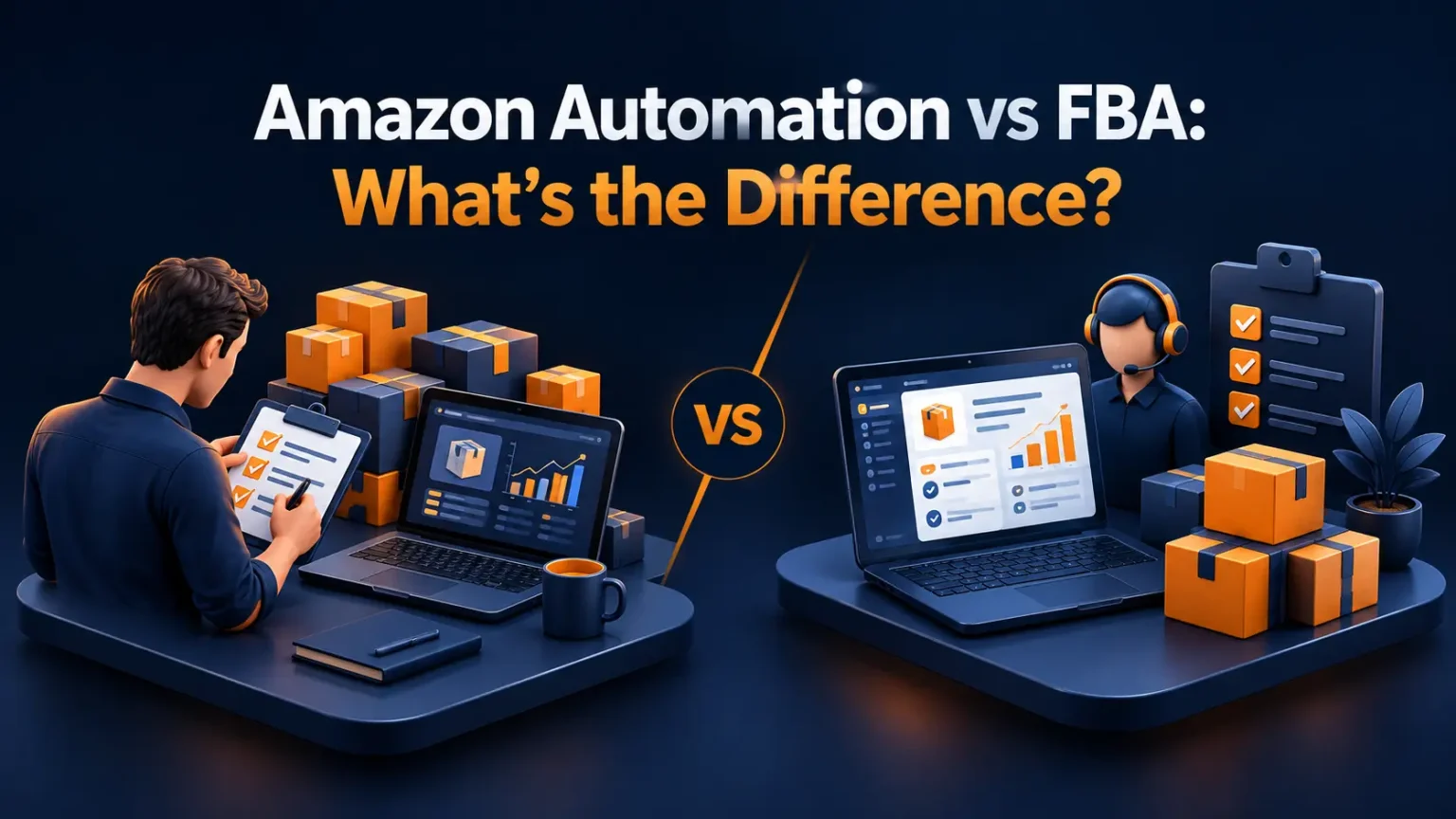
A friend texted me last month. He’s got a day job, two kids, and maybe four free hours a week, and he wanted to know whether to try Amazon automation vs FBA. Basically: do it yourself, or pay someone to run the store? I gave him a long answer over coffee. This is the cleaner version, and it’s meant for anyone stuck at the same crossroads.
What Traditional Amazon FBA Really Involves
FBA stands for Fulfillment by Amazon. You buy a product, ship it to an Amazon warehouse, and Amazon takes it from there. They store it, pack it, send it out, and handle returns.
Sounds easy, right? The shipping part is. Everything before the shipping is on you: picking the product, haggling with suppliers, writing the listing, and running ads. I like to say Amazon FBA is a shop where someone else drives the van.
What a Normal Week Looks Like
It’s messy, honestly. Monday you’re stuck comparing supplier quotes. By Wednesday a competitor drops their price, and you’re rewriting your listing at 11 pm.
New sellers usually guess an hour or two a week. Most people I’ve talked to say it was far more at the start. I can’t give you a solid number, since it depends on your product and how quickly you pick things up.
Where FBA Beginners Usually Get Stuck
Product research is the first wall. There are thousands of ideas out there, and it’s hard to tell a good one from a money pit. Many beginners spend weeks on spreadsheets and still feel unsure.
Then comes the supplier side. Samples arrive late, messages go unanswered, and quality can differ from what you were promised. Ads add another layer, because you can burn through a budget fast if you don’t know what you’re doing.
None of this means FBA is a bad idea. It just means the first few months are a real education, and you should be ready for that.
What Is Amazon Automation?
Here, a company runs most of the store and you stay the owner. You put up the money. They handle research, sourcing, listings, and the daily grind.
You’ll also see them called Amazon store management services. Don’t assume two companies offer the same thing, because they really don’t. Some do a lot, and some do very little.
People call it hands-off, and that’s mostly fair. But you’ll still approve budgets and read reports. And the quality gap between providers is huge, so do your homework before you commit.
What a Good Provider Should Be Doing
A solid team should be able to explain how they pick products and who they buy from. They should also tell you how they handle ads, and how often you’ll get updates. If they can’t explain these things in plain English, that tells you something.
You don’t need to understand every detail. You just need to understand enough to know your money isn’t disappearing into a black box.
Amazon Automation vs FBA: Where They Actually Differ
Four things matter most: time, cost, control, and risk. Let’s take them one at a time.
Amazon Automation vs FBA on Time and Effort
Doing FBA yourself eats real hours, especially early on. Automation cuts that down because a team does the heavy work. Still, you can’t vanish. A store nobody watches tends to run into trouble.
Cost and Investment
FBA can start cheaper if you test one small product. Automation usually asks for more cash up front, because you pay for the service and the stock. Fees swing wildly between companies, so I won’t guess a figure. Get every cost in writing first.
Control and Learning
Run it yourself and every call is yours. You also walk away with a skill. Hand it off and you get your evenings back, but you learn less. Neither is wrong, it just depends on what you’re after.
Risk
Both can lose money. With FBA, the danger is usually your own slip, like a weak product pick. Automation adds a second worry: the provider. A pushy or vague company can burn your cash and even cause account headaches.
Pros and Cons of Doing FBA Yourself
The big win is ownership. You choose what to sell, and you see every number. Over time, you build know-how nobody can take from you.
The cost is the learning curve. Mistakes hurt your wallet, and the first product rarely lands. With a job and kids on top, it can get exhausting.
Picture Sara, an accountant working on her store at night. She picks a kitchen gadget and misses a quality problem with the supplier. Bad reviews pile up, and she pauses sales for a few weeks. She learned a ton, but it stung.
Pros and Cons of Using Amazon Automation
You save time. That’s the whole appeal. A decent team has done this before, so you skip a lot of beginner trial and error.
Then again, you pay for that, and you give up some control. You’re also trusting someone else to keep their word. Some providers are solid. Others aren’t.
Take Ahmed, a project manager who’s on the road every other week. He can’t check his account daily, so he hired a store management service. They send him a weekly report and ask before big changes. It worked because he picked a company that answered his questions without dodging.
Now compare him with Bilal, who signed up with the first company that gave him a discount. He never asked for references and barely read the contract. A few months later, he couldn’t get clear answers about where his money had gone. The lesson isn’t that automation fails. It’s that rushing the choice of provider is where most of the pain starts.
Who Usually Fits Which Path?
Let’s get practical. People with a flexible schedule, a curious mind, and a smaller budget often lean toward FBA. They don’t mind spending evenings on research because they want to learn the business inside out.
On the other hand, busy professionals tend to lean toward automation. They have more money than free time, and they’d rather pay for experience than spend a year making beginner mistakes. If that sounds like you, Amazon automation may be worth a serious look.
Some people sit in the middle. They want help, but they also want to understand what’s happening in their own store. For them, a provider who shares reports and explains decisions is far better than one who says “just trust us.”
So Which One Fits You?
Ask yourself two things. Can you spare a few hours every week to learn this? And do you want the skill, or just the result?
If you enjoy figuring things out and your schedule has some give, go with FBA. If your calendar is packed, Amazon automation might suit you better. In the end, Amazon automation vs FBA is mostly a trade between time and control.
There’s a middle route too. Watch a few free tutorials on FBA basics first, then decide. You’ll spot a weak sales pitch much faster.
Questions to Ask Before Hiring a Provider
If you go the automation route, don’t be shy about asking questions. A good company won’t mind. A shady one will get defensive.
Ask who owns the store and the seller account. Ask how products get chosen, and what happens if a product doesn’t sell. Find out what the fees cover and what costs extra. And ask for real clients you can speak to, not just screenshots.
Write the answers down. If anything changes later, you’ll have a record to point to.
Mistakes Worth Avoiding
Some errors hit both paths. Skip them and you’ll save real money.
Don’t buy into income promises. No honest provider can guarantee profit, and I can’t predict your results either. Read the contract slowly and check that you own the store and the seller account. Vague paperwork? Walk away.
Watch your numbers even when someone else runs things. Sales, ad spend, and stock reports should make sense to you. And don’t rush. Slow and careful usually wins.
Your Next Step
So that’s the core of Amazon automation vs FBA. One path gives you control and a skill, the other gives you time back. Neither is a shortcut to easy money.
Grab a pen and jot down two numbers: the hours you can give each week, and the amount you’re ready to invest. If automation appeals, book calls with two or three providers and compare their answers. If FBA does, pick one small product idea and research it this week.
Which way are you leaning? Start there today.