
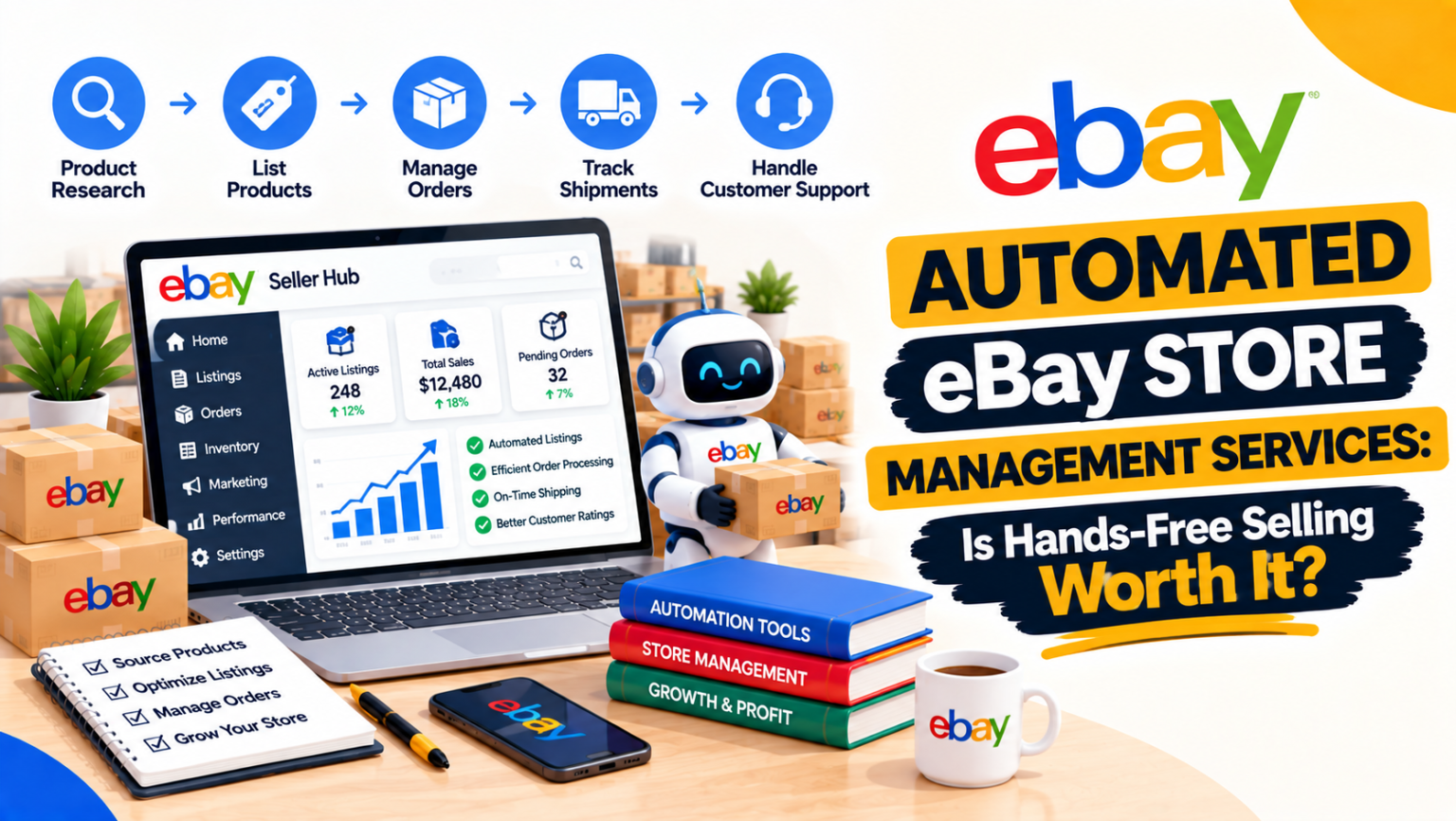
If you spend any time reading e-commerce forums or watching financial side-hustle videos, you have probably run into the pitch: buy an automated store, let a third-party team handle the daily grind, and sit back while hands-free profits roll into your bank account.
It sounds like the ultimate passive income model. But once you strip away the polished sales pages, what does an automated eBay store actually look like in practice? More importantly, is paying someone else to manage your storefront a smart investment, or are you taking on hidden financial risks?
Here is a realistic look at how automated eBay store management services operate, what they cost, the severe policy traps you need to dodge, and whether “hands-free” selling actually delivers.
What Is Automated eBay Store Management?
At its core, automated eBay store management means handing over routine, high-volume operational tasks like creating listings, monitoring stock levels, tweaking prices, and dispatching orders to external systems or specialized management teams.
Software-Driven Automation vs. Fully Managed Agencies
Sellers generally approach automation in two completely distinct ways:
- Software-Driven (Self-Managed): You maintain total ownership of your store, but you plug standalone software tools into your account. These programs update inventory count, match competitor pricing, and automate customer message templates. You remain the decision-maker, but software handles the busywork.
- Done-For-You Agencies (Turnkey Investment): You pay a third-party agency an upfront management fee plus a monthly cut of profits. They handle everything from finding suppliers to processing customer refunds. You supply the capital; they act as the day-to-day operators.
What Does “Hands-Free” eBay Selling Actually Mean?
In reality, true 100% hands-free selling is a myth. Even if you hire an agency to manage daily activities, you are still responsible for approving corporate bank transfers, dealing with tax filings, reviewing monthly profit margins, and serving as the primary legal owner on the account.
Core Features: How Automated eBay Management Works Daily
Running a successful store requires managing dozens of moving parts continuously. Modern automation tools and agency teams rely on four main operational pillars to keep things running:
Automated Inventory Tracking & Multi-Channel Syncing
Out-of-stock cancellations trigger severe seller penalties on eBay. Automated inventory management software connects your supplier’s warehouse feed directly to your listing catalog. If a distributor’s stock drops to zero, your eBay listing automatically pauses to prevent unfulfillable orders.
Dynamic Repricing and Competitor Price Matching
Competitors change prices constantly to win search placement. Repricing tools monitor competing listings around the clock, raising or lowering your prices in real time to capture sales without dipping beneath your set profit margin floor.
Hands-Free Order Fulfillment and Tracking Updates
When a buyer purchases an item, automation tools route order details, shipping addresses, and payment data directly to your warehouse or supplier. Once the package ships, the software pulls the carrier tracking number and uploads it directly to eBay to keep your account health metrics green.
Automated Customer Service and Feedback Management
Handling messages manually takes hours. Automated store management setups use templated messaging triggers to send instant order confirmations, tracking links, and follow-up requests for positive seller feedback, flagging complex issues for human review.
The Popular Business Models Used in Automated eBay Stores
Your store’s profitability—and its long-term survival depends heavily on the product sourcing strategy used behind the scenes:
The Wholesale & Warehousing Model (Lower Policy Risk)
In this model, products are sourced in bulk directly from verified distributors or brand owners and stored in domestic fulfillment centers.
- Pros: Fully compliant with eBay rules, stable supply chains, and reliable shipping times.
- Cons: Requires higher upfront capital to purchase bulk inventory before making sales.
The Retail Dropshipping Model (High Suspension Danger)
Some low-tier automation agencies attempt to cut corners by listing products from consumer retail websites like Amazon, Walmart, or Home Depot. When an eBay user buys from your store, the agency orders the item on Walmart’s site and ships it directly to the customer in a branded retail box.
- The Reality: Retail dropshipping directly violates eBay’s strict policy on fulfillment. eBay actively detects retail packaging codes and automatically flags, buries, or permanently bans accounts using this method.
Private Label and Branded Product Sourcing
You work with overseas or local manufacturers to produce custom-branded items, creating dedicated catalog listings on eBay.
- Pros: Higher profit margins and zero competition on your exact product page.
- Cons: Longer launch times, market research costs, and manufacturing lead times.
The Real Costs: How Much Does eBay Automation Service Cost?
Before jumping in, you need a clear breakdown of the true capital required to get an automated store off the ground:
Upfront Setup Fees vs. Monthly Profit-Sharing Models
Turnkey management agencies rarely work cheap. Most charge an upfront onboarding fee ranging from $5,000 to $30,000 just to build the store and set up supply pipelines. On top of that, they usually demand a 20% to 50% cut of your monthly net profits.
Hidden Costs: Software Licenses, Returns, and eBay Final Value Fees
Management fees are only part of the equation. You are also on the hook for:
- Software Subscriptions: $100 to $500/month for repricing, listing, and inventory syncing tools.
- eBay Selling Fees: eBay takes roughly 12% to 15% in Final Value Fees on every transaction.
- Returns & Fraud: Defective items, return shipping labels, and buyer claims come straight out of your margin.
How Much Working Capital Do You Actually Need?
Beyond setup fees, you need liquid cash reserves to buy inventory and float order payments before eBay releases your payout funds. A realistic starting budget requires $3,000 to $10,000 in liquid capital on top of agency charges.
Major Risks and Danger Flags to Consider Before Investing
Handing total operational control of your storefront to an external agency comes with significant hazards:
eBay’s Strict Policy on Dropshipping and Third-Party Sellers
eBay actively updates its fraud-detection algorithms to catch unauthorized third-party operators. If your agency uses black-hat listing techniques, buys fake reviews, or uses retail dropshipping, your seller dashboard will get hit with account restrictions or permanent bans.
Account Ownership and Personal Financial Liability
Here is what agency sales reps usually skip over: eBay accounts are tied directly to your legal identity, Social Security Number, and corporate entity. If an agency breaks policy, buys counterfeit goods, or defaults on customer refunds, you personally take the credit damage, legal liability, and tax consequences—not the agency.
Red Flags: “Guaranteed ROI” and Unrealistic Passive Income Claims
E-commerce markets fluctuate. Shipping costs rise, ad rates shift, and buyer demand changes. Any agency promising “guaranteed 30% monthly returns” or risk-free passive wealth is using marketing pressure to collect an upfront setup check.
Software Tools vs. Done-For-You Agencies: Side-by-Side Comparison
| Feature | Self-Managed with Software | Done-For-You Management Agency |
| Operational Control | Full control over listings, suppliers, and pricing policies. | Relinquished completely to an external team. |
| Upfront Cost | Low ($50 to $300/month for software subscriptions). | Very High ($5,000 to $30,000+ setup fees). |
| Ongoing Overhead | Software costs + physical inventory. | Software fees + profit split + inventory cash flow. |
| Account Risk | Minimal (when using official eBay APIs). | High (dependent entirely on the agency’s ethics). |
| Time Commitment | 5 to 10 hours/week of strategic oversight. | 1 to 2 hours/week reviewing financial statements. |
Final Verdict: Is Hands-Free eBay Selling Worth It?
If your goal is to build a legitimate, long-term business, software-driven self-automation is by far the better route. Using specialized software tools to handle repricing, inventory syncing, and customer communications gives you massive operational leverage without forfeiting account control or paying massive upfront fees.
Hiring a full-service “Done-For-You” agency is rarely worth the extreme financial risk for beginner sellers. If you evaluate an agency anyway, treat it like a high-risk private equity investment: thoroughly audit their supplier invoices, verify brand authorization letters, check their long-term track record, and never give external contractors master access to your primary banking details.