
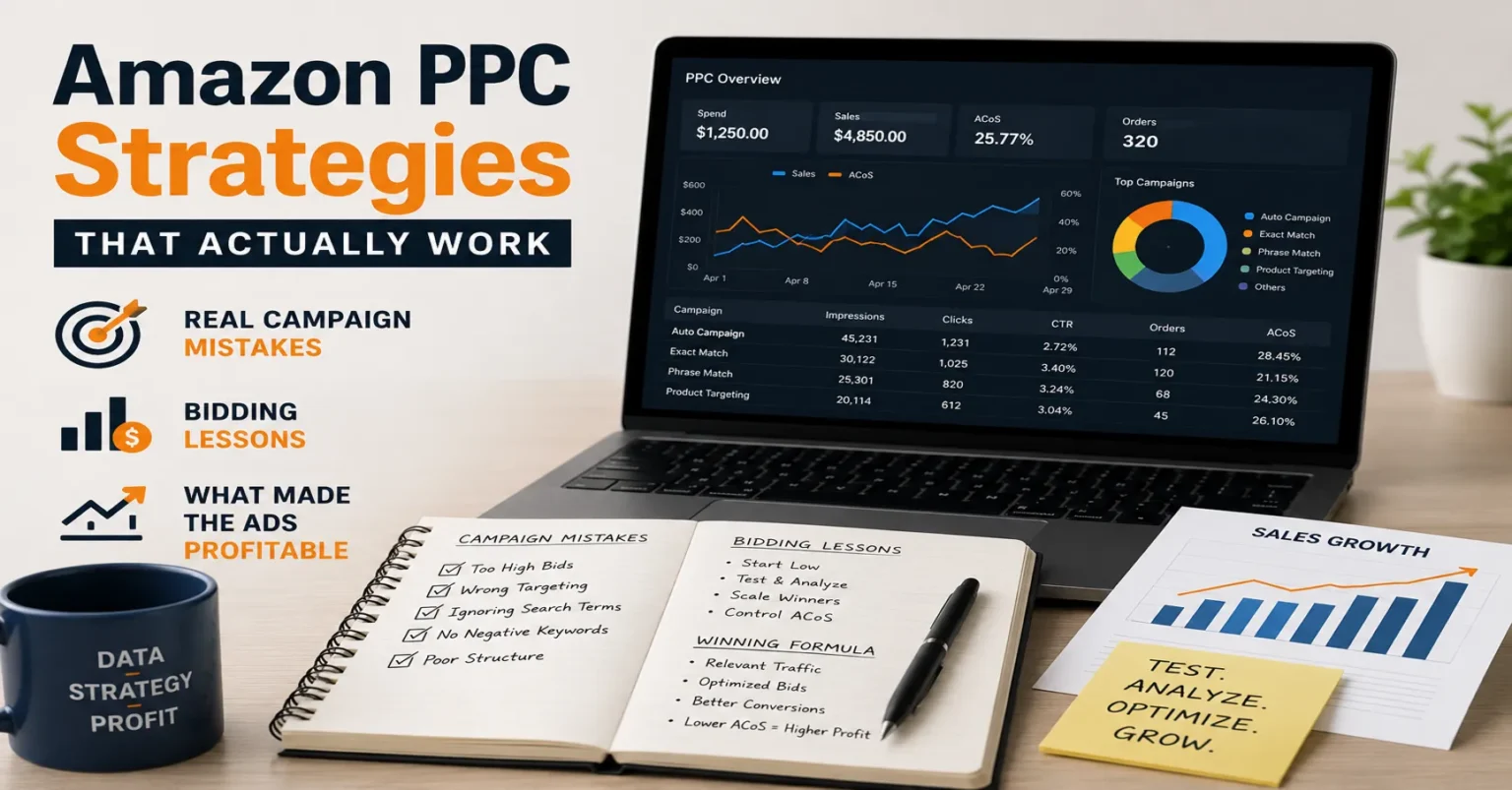
The first time I ran Amazon ads I did it the way most people do it the first time. I clicked through the setup, accepted most of the default settings, set a daily budget that felt manageable, and assumed the platform would figure out the rest. Understanding real amazon ppc strategies was something I thought I could skip because the interface made everything look simple enough to handle on instinct.
That assumption cost me about six hundred dollars over five weeks before I accepted that I had no idea what I was doing.
Why Amazon Ads Feel Simple Until They Are Not
Amazon has done a genuinely good job of making the ad setup process feel approachable. A few clicks, a budget, some keywords if you want them, and your campaign is running. The problem is that approachable setup and effective campaign management are two completely different things and the gap between them is where most new sellers lose money quietly for longer than they should.
The interface does not tell you that your automatic campaign is burning budget on search terms that have nothing to do with your product. It does not tell you that your bids are set too high for keywords that convert poorly or too low for keywords that could dominate if you gave them more room. It does not tell you that the campaign structure you set up in the first week is working against you in ways that will not be obvious until you look at the data carefully several weeks later.
I learned all of those things the expensive way. Most of this piece is about what I figured out after those first five wasted weeks.
Understanding What Amazon PPC Actually Is Before Anything Else
I want to spend a moment on this because I think a lot of sellers jump into the tactical stuff without having a clear mental model of what the system actually is and how it works, and that missing foundation makes the tactics harder to apply correctly.
Amazon PPC is a pay per click advertising system where you bid on keywords or targeting criteria and pay Amazon each time a buyer clicks on your ad. Your ad appears in search results and on product pages. Whether your ad shows up for a given search depends on your bid relative to competing bids, the relevance of your listing to that search, and a few other factors the algorithm weighs. You pay for clicks regardless of whether those clicks result in sales, which means the relationship between your click costs and your sales revenue is the central financial equation you are always trying to manage.
The metric most sellers learn to watch first is ACoS, which stands for Advertising Cost of Sales. It represents your ad spend as a percentage of the revenue those ads generated. A lower ACoS means your ads are more efficient. What counts as a good ACoS depends on your margins, which is why two sellers in different categories can look at the same ACoS number and one will be happy and one will not.
Getting comfortable with these basics before running campaigns is not optional. Every strategic decision you make will be based on reading this data correctly and you cannot do that if you do not understand what the numbers mean.
The Campaign Structure That Actually Works
Start With Automatic Campaigns for Research Not for Sales
This was the first real shift in how I thought about Amazon ads and it changed my results more than anything else I learned in the early months. Automatic campaigns are campaigns where you let Amazon decide which searches to show your ads for based on its own assessment of your listing’s relevance. Most new sellers run automatic campaigns because they are easier to set up and hope they will generate sales efficiently.
They often do generate some sales. But their primary value, which most people miss entirely, is as a research tool. An automatic campaign running with a modest budget over three or four weeks will show you exactly which search terms actual buyers are using when they find and click on your product. That data is genuinely valuable because it tells you which keywords deserve your serious attention in manual campaigns where you have real control over bids and placement.
I run automatic campaigns continuously at a controlled budget specifically to keep collecting this search term data. Every few weeks I go through the search term report, pull out the terms that have been converting, and add them to my manual campaigns with proper bids. The automatic campaign feeds the manual campaigns and the manual campaigns are where I do the serious work.
Manual Campaigns Are Where You Actually Control Your Results
Once you have keyword data from your automatic campaigns, manual campaigns are where amazon ppc strategies start to produce real results. In a manual campaign you choose exactly which keywords to target and exactly how much to bid on each one. That control is what allows you to be efficient rather than just present.
The structure I use separates keywords by match type into different campaigns or at minimum different ad groups. Exact match means your ad only shows when someone searches for precisely that keyword. Phrase match means your ad shows when a search contains your keyword as part of a longer query. Broad match gives Amazon more flexibility to show your ad for related searches.
Each match type serves a different purpose. Exact match on your best converting keywords gives you precise control over your most valuable traffic. Phrase match catches variations and longer queries around those keywords. Broad match continues the research function of finding new search terms you had not thought of. Running all three and understanding what each one is doing is what separates sellers who manage campaigns intentionally from sellers who just have campaigns running.
Bidding and Why Most People Get It Wrong
I spent a long time either overbidding on keywords that did not convert well or underbidding on keywords that could have driven significant volume if I had given them more budget. Both mistakes cost money and both stem from the same underlying problem which is not knowing the actual value of a click for a specific keyword.
The value of a click depends on the conversion rate for that keyword and your profit margin on the sale. A keyword that converts one in every ten clicks is worth five times as much per click as a keyword that converts one in fifty, assuming the sale value is the same. Setting bids without knowing conversion rates means you are essentially guessing, and guessing with your ad budget is a slow way to lose money.
What I do now is start new keywords at a conservative bid, let them run long enough to gather statistically meaningful data, and then adjust bids based on actual performance. Keywords that are converting well get bid increases to capture more of that traffic. Keywords that are getting clicks but not converting get bid reductions or get paused if the pattern persists long enough to be conclusive. This sounds obvious when you write it out but doing it consistently and patiently is what separates campaigns that improve over time from campaigns that just run.
Negative Keywords Are Half the Job
What Negative Keywords Are and Why They Matter
A negative keyword is a search term you tell Amazon you do not want your ad to show for. If you sell premium leather wallets and your ads keep showing up for searches like cheap wallets or wholesale wallets, you are paying for clicks from buyers whose intent does not match your product. Adding those terms as negative keywords stops Amazon from spending your budget on those searches.
This sounds simple and the concept is simple. But doing it well requires regular attention to your search term reports and a willingness to add negatives consistently rather than occasionally. Every irrelevant search term that eats your budget without converting is money that could have gone to the keywords that actually sell your product.
When I first started taking negative keywords seriously the efficiency of my campaigns improved noticeably within a few weeks. Not because I had found better keywords to bid on but simply because I had stopped wasting money on the wrong searches. Sometimes the improvement comes from addition and sometimes it comes from subtraction.
Building a Negative Keyword List Before You Launch
One thing I wish I had done from the beginning was build a starter negative keyword list before launching my first campaigns rather than waiting for the search term reports to tell me what to exclude. There are categories of search terms that are almost universally irrelevant for most product sellers and adding them as negatives from day one saves you from paying for that traffic during the research phase.
Terms indicating the buyer wants something free, wholesale, bulk, used, or DIY are often safe to exclude from day one depending on your product. Competitor brand names that you cannot win against are worth considering. Searches that indicate a completely different use case than what your product serves should go on the list early.
Starting with a clean negative list means your campaign data from the first weeks is less contaminated by irrelevant traffic and you can make better decisions faster.
Product Targeting Campaigns and Why I Underestimated Them
For a long time I focused almost entirely on keyword targeting and largely ignored product targeting campaigns. Product targeting lets you place ads on specific competitor product pages or on pages within a specific category. I thought of it as a secondary tactic and gave it minimal budget. That changed after a campaign I ran almost by accident.
I changed my mind after a campaign I ran almost by accident. I set up a product targeting campaign against a specific competitor whose product had a lot of reviews but was clearly not satisfying buyers based on the review content. The conversion rate on that campaign turned out to be significantly higher than my keyword campaigns for the same period and I eventually understood why. Buyers landing on that competitor’s page through search were already in a buying mindset for that category of product. Seeing my ad as an alternative option on a page where they were already considering a purchase was a much warmer context than a cold search result.
Product targeting now gets a meaningful share of my ad budget and the amazon ppc strategies I would recommend to anyone include building this campaign type out properly rather than treating it as an afterthought.
The Budget Conversation Nobody Has Honestly
How much you should spend on Amazon ads is a question that gets answered vaguely in most places and I think sellers deserve a more honest answer even if that answer is complicated.
The right budget depends on your margins, your goals, and what phase of selling you are in. Early in a product’s life on Amazon, when it has no sales history and no reviews, ads are doing two jobs simultaneously. They are generating sales directly and they are building the sales velocity and conversion data that improve organic rankings. During that phase spending more aggressively than your current ACoS would suggest is rational can make strategic sense because you are buying ranking position that will pay off in organic traffic later.
Once a product is established and ranking organically for its main keywords, the calculus changes. Now you are looking more carefully at profitability and trying to run ads efficiently rather than aggressively. The acceptable ACoS at this stage should be based on your actual margin rather than on what feels comfortable.
What I tell people who ask me about budget is to think about the minimum spend that allows you to gather enough data to make real decisions. Running a campaign on five dollars a day is so slow that it takes months to accumulate the data you need to optimize properly. Running at a level that generates enough clicks and conversions to be statistically meaningful is what allows you to improve at a pace that actually matters.
What Consistent Campaign Management Actually Looks Like
One of the things that surprised me most when I started taking amazon ppc strategies seriously was how much of the work is not about setup but about ongoing management. A well structured campaign that nobody looks at for six weeks will drift. Bids that made sense in week one may not make sense in week six if conversion rates have changed, if competition has increased, or if seasonal factors have shifted demand.
My routine now involves checking campaign performance twice a week at minimum. Reviewing which keywords are spending and converting, which are spending without converting, and which are not spending at all when they should be is a weekly ritual. Search term reports get pulled every week and processed for new negatives and new keyword opportunities. Bids get adjusted on anything with enough data to make a judgment, while anything without enough clicks to be conclusive gets left alone.
This sounds like a lot of work and in the early stages it is. As campaigns mature and the structure becomes more refined the ongoing management gets lighter because you have already done most of the heavy work of finding what works. But never fully stepping away from it is one of the habits that separates sellers who maintain good performance from sellers who wonder why their results have quietly deteriorated.
What I Would Tell Someone Setting Up Their First Campaign Today
Start with a small automatic campaign and give it three to four weeks to collect search term data before you make major decisions. Do not try to optimize too early because you need volume to make decisions meaningfully.
Build your first manual campaigns around the converting search terms that come out of that data. Separate match types so you can control them independently. Add negative keywords from the beginning and keep adding them every week.
Watch your ACoS but do not obsess over it in isolation. Understand what ACoS is acceptable given your specific margins and use that as your benchmark rather than chasing a number someone told you was good without knowing your numbers.
Be patient with the process. Amazon PPC is not a switch you flip and walk away from. It is a system you build and refine continuously and the sellers who get the best results over time are the ones who stay engaged with it consistently rather than the ones who set it up once and hope for the best. The platform rewards attention and patience more than it rewards any single clever tactic.