
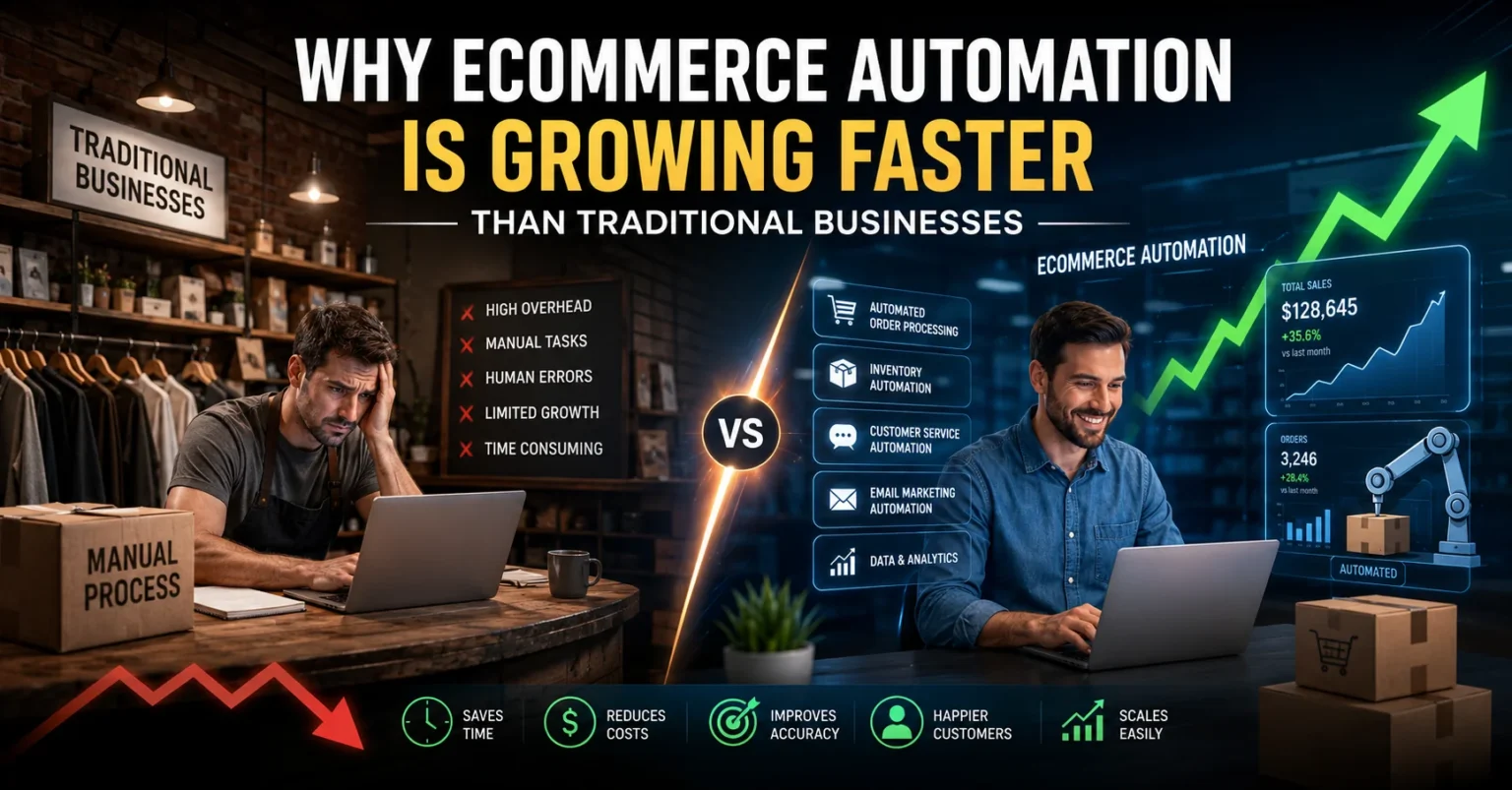
Few years back, I was running my store from a laptop on my kitchen table. Three sales channels, zero systems, and one very bad night where I sent the wrong order to a guy in Texas. He wasn’t happy. I wasn’t happy. And somewhere in that chaos I figured out that doing everything by hand wasn’t hustle, it was stupidity. That’s honestly how I got obsessed with ecommerce automation, and looking at how fast online businesses are growing compared to traditional ones, I don’t think I was the only person who had that wake-up call.
The Real Reason Traditional Businesses Are Falling Behind
Walk into any traditional store and you’ll notice something. Everything depends on people being present. Someone has to open the shop, help the customer, ring them up, restock the shelf. That’s fine when you’re small, but the moment you want to grow, every step costs you more money and more headcount. Want a second location? Double the rent, double the staff, double the headaches. The math just doesn’t work in your favor.
Online businesses don’t carry that same weight. You build something once and it can handle ten orders or ten thousand without you adding a single employee. When you layer in automation on top of that, the gap between what ecommerce can do and what a physical store can do becomes almost unfair.
Traditional retail also has a fragility problem that software can’t fix. One sick employee at the checkout counter and your line backs up. Your warehouse manager goes on holiday and shipments slow to a crawl. Ecommerce automation quietly eliminates most of those weak points because the system just keeps running, day or night, whether you’re watching or not.
What Ecommerce Automation Actually Looks Like in Practice
Most people picture robots when they hear automation. Giant warehouses with machines flying around. And yeah, that exists. But the automation that’s actually changing the game for most ecommerce sellers is boring by comparison. It’s invisible. It’s just a bunch of triggers and rules firing in the background while you sleep.
Order Fulfillment That Runs on Its Own
Someone buys something from your store. Before you’ve even seen the notification, the inventory count has already updated, the fulfillment request has gone to the warehouse, the shipping label is printed, and the customer has a confirmation in their inbox. That whole chain happens in seconds without a single person lifting a finger. Now think about a traditional retailer doing the same thing manually, updating a spreadsheet, calling a supplier, printing paperwork. That’s not just slower, it’s a completely different league.
Customer Service That Does Not Sleep
Refund requests, tracking questions, return instructions, these used to mean hiring people to sit at a desk answering the same five questions over and over. Now a properly set up chatbot handles most of it. A customer messages at midnight asking where their parcel is, they get an answer in ten seconds. No agent needed, no morning delay, no frustration.
Email and Marketing on Autopilot
This is where I’ve personally seen the biggest impact. Someone leaves your site without buying? An email hits their inbox within the hour. Buy three times, and a customer can be added to a VIP segment automatically. After three months of inactivity, the system may trigger a personalized re-engagement campaign. A re-engagement sequence kicks off on its own. None of this needs you to press anything. It just runs, and it just makes money.
The Numbers That Tell the Story
The market data on ecommerce automation isn’t subtle. The sector has been growing at a pace that makes most traditional industries look stuck in neutral. The pandemic pushed a lot of people online faster than anyone expected, but the real driver was always simpler than that. Automation cuts costs, reduces errors, speeds everything up, and makes growth feel less painful. Once a business owner experiences that, they don’t go back to doing things manually.
What’s interesting is how much this has helped smaller sellers. A one-person shop can now deliver the kind of fast, personalized experience that used to require a full customer service team. The playing field isn’t perfectly level, but it’s a lot closer than it used to be.
Why Scalability Changes Everything
Let me tell you about something I watched happen with a friend who sells handmade soaps. She was doing everything herself, making the product, listing it, packing orders, replying to every message. Business picked up and instead of feeling good about it, she was drowning. More sales just meant more stress.
She spent a few weeks setting up proper automation. Inventory tracking with reorder alerts. Automated order routing. Email sequences for new customers and lapsed ones. She told me afterwards that it felt like hiring three people except nobody needed a salary or a day off.
A bakery owner doesn’t get that option. You can’t automate kneading dough. A plumber can’t send a bot to fix a pipe. Their time is the product, and there are only so many hours in a day. Ecommerce sellers, when they set things up properly, are not fighting that same ceiling.
Lower Overhead, Higher Margins
The financial case for automation is pretty straightforward once you see the numbers. Fewer staff needed for repetitive tasks means your payroll doesn’t balloon as revenue grows. Fewer human errors means fewer returns and reshipments eating into your margins. Faster responses mean happier customers who come back and buy again. All of that hits the bottom line in a good way.
Physical retail doesn’t have the same flexibility. Your rent is the same whether you had a busy Saturday or a dead one. Staff hours have to be scheduled in advance. Fixed costs stay fixed. Ecommerce businesses, especially leaner ones running solid automation, can flex in ways that traditional businesses genuinely cannot.
The Human Element Still Matters, Just Differently
I’ll be straight with you here because I think this point gets missed a lot. Automation isn’t about removing people from your business. It’s about removing people from the parts of your business that don’t actually need them.
The sellers doing this really well aren’t just automation nerds. They’ve figured out where a human being genuinely adds something and where a human being is just a bottleneck. A tricky customer complaint that needs real empathy and creative thinking, that needs a person. A shipping confirmation going out at 3am, absolutely does not.
Personalization at Scale
This is honestly one of the more remarkable things automation has made possible. An online store today can show different product recommendations to different customers based on what they’ve browsed, remember what someone bought six months ago, send emails with subject lines tailored to individual behavior, and adjust pricing dynamically. All of that is running automatically. To do any of it manually at scale would require a team of hundreds.
A physical store relies on a shop assistant remembering your name and your usual order. That’s lovely when it happens, but it doesn’t scale. Automation makes personalization something every ecommerce business can offer, not just the massive ones.
Where the Gap Will Keep Growing
The honest truth is that this gap isn’t closing anytime soon. AI is making automation sharper. Systems that used to need someone to write rules are now learning on their own. Forecasting is getting better. Inventory management is getting smarter. The whole infrastructure keeps improving and every improvement applies directly to ecommerce businesses in a way it simply can’t for physical retail.
Traditional businesses are trying to catch up with technology, and some are doing a decent job of it. But they’re working around a core constraint. Their operations are physical and that will always put a ceiling on how much automation can help them.
The ecommerce sellers who figured this out early built businesses designed to grow through systems rather than through grinding harder. That bet is paying off now in a very visible way.
If you’re running an online store and still doing things manually that a good system could handle, that’s worth rethinking. The businesses pulling ahead aren’t always the ones with the best product. More often, they’re the ones who built smart systems around a decent product. And at the center of most of those systems is ecommerce automation doing the heavy lifting.